
This isn't an overview of everywhere rhino happen to live in Africa — plenty of parks, including Tanzania's Ngorongoro Crater, hold small populations that don't feature here. It's a guide to the places I'd actually send a client for a reliable rhino sighting: reserves and conservancies with the numbers, the management and the tracking infrastructure to make seeing one a near-certainty rather than a hopeful bonus. On that basis, Kenya's Laikipia conservancies, Nairobi National Park, Ol Chorro and Sera Conservancy, South Africa's Greater Kruger private reserves, Namibia's rhino-tracking reserves from Damaraland to Etosha, and Uganda's Ziwa Rhino Sanctuary are where I focus. Where you go depends on which species you want to see, and how close you want to get.
Of all the animals I plan safaris around, rhino carry a weight the others don't quite have. Every sighting is shadowed by the same fact: these are among the most heavily poached large mammals on earth, and in some of the places I've watched them graze, armed rangers were never more than a few hundred metres away. Seeing a rhino in the wild today is not a given. It's the result of a huge amount of deliberate, expensive, dangerous conservation work, and I think that's worth knowing before you go.
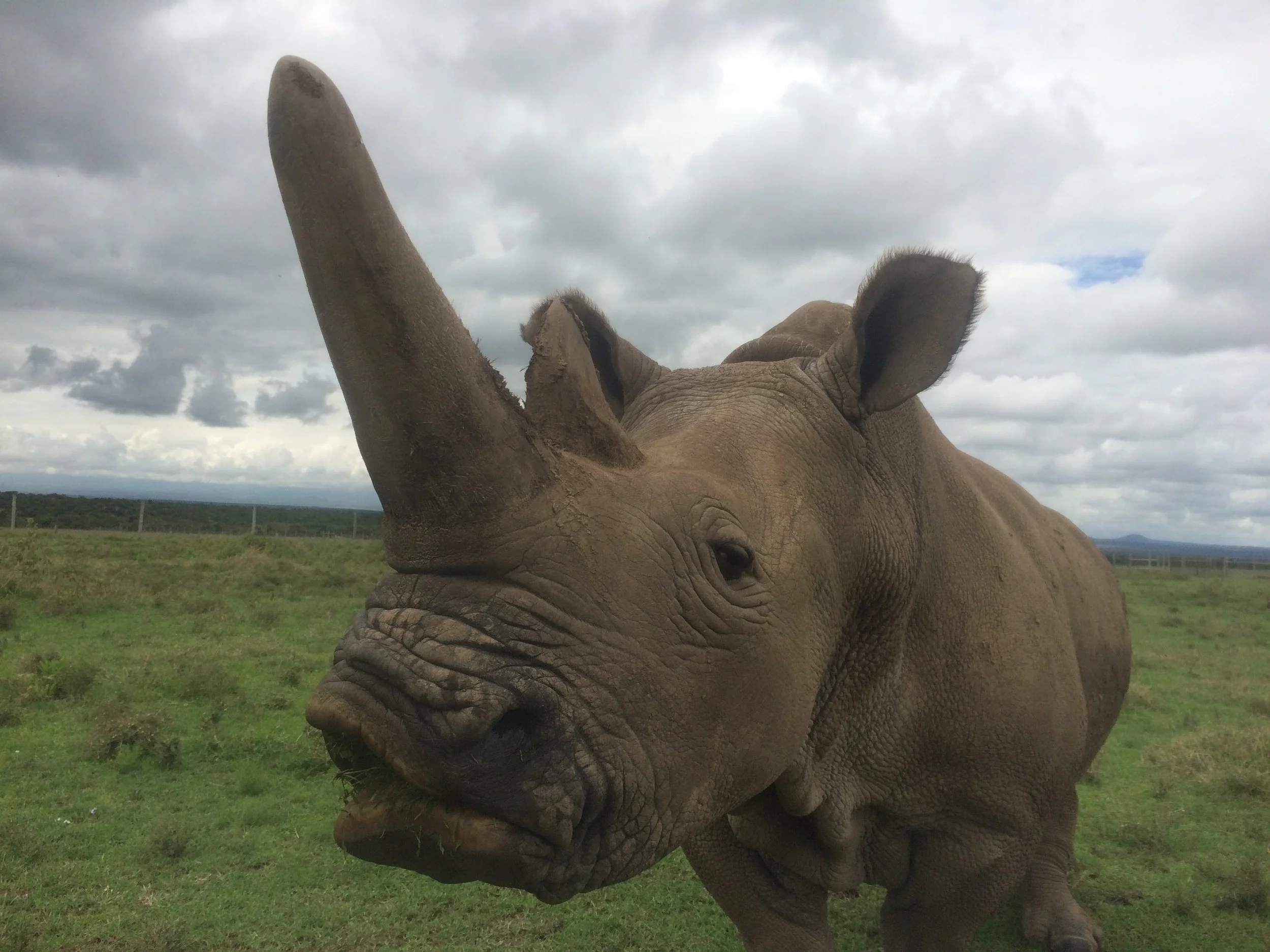
📸 : Fatu, one of only two remaining Northern White Rhinos at Kenya’s Ol Pejeta Conservancy.
Black Rhino or White Rhino? Why the Difference Matters
The names have nothing to do with colour — both species are the same grey. The distinction that matters is the shape of the lip, which tells you everything about where you'll find each one.
| White Rhino | Black Rhino | |
|---|---|---|
| Population | Around 17,000–20,000 — Near Threatened | Around 6,000 — Critically Endangered |
| Lip shape | Square, wide lip for grazing grass | Hooked, pointed lip for browsing leaves and shrubs |
| Build & temperament | Larger, bulkier, generally more placid and often seen in small groups | Smaller, more compact, more solitary and can be considerably more highly strung |
| Habitat | Open grassland and savannah | Denser bush and woodland |
Namibia: Rhino Tracking on Foot, From the Desert to Etosha
If your priority is simply seeing a rhino, white rhino are the more reliable option almost everywhere on this list. If you specifically want black rhino, your destination options narrow considerably — and that's exactly the kind of detail worth telling me early on.
Lucie’s Random Fact! There's a good trick for telling the two apart even without seeing the animal itself: rhino share communal dung piles called middens, and the contents give it away immediately. A white rhino's midden is almost entirely poorly digested grass. A black rhino's contains twigs and small branches, and every single piece has been bitten off at a neat 45-degree angle — a direct result of how its hooked lip and molars work together as it browses. Once a guide has pointed this out to you, you'll never mistake one for the other again.
Where to See Rhino
Kenya: The Laikipia Plateau and Beyond
Over half of Kenya's entire black rhino population now lives across Laikipia's network of private and community conservancies, and it's this collective model — land set aside, communities benefiting directly from conservation, and conservancies working together on translocations — that has driven Kenya's rhino recovery as much as any single reserve has.
Ol Pejeta Conservancy holds the largest black rhino sanctuary in East Africa, alongside a healthy white rhino population — and it is also home to Najin and Fatu, the last two northern white rhinos left on the planet, kept under permanent, dedicated protection.
Neighbouring Lewa Wildlife Conservancy is equally strong for both species, with excellent tracking and a conservation model that has become a template for community-run wildlife areas across Kenya.
Loisaba Conservancy has one of the best rhino stories in Kenya right now: in early 2024, 21 black rhino were translocated there from Nairobi National Park, Ol Pejeta and Lewa — the first rhino Loisaba had seen in around 50 years, since poaching wiped them out. Their return completed Loisaba's Big Five, and it's a genuinely moving thing to be part of a landscape's rhino population being rebuilt within living memory.
Lucie's recommendation: A visit to Ol Pejeta is a very moving experience, to meet Najin and Fatu, the last 2 Northern White rhinos in the world, but also to hear about the pioneering work taking place to try and save the species.
My Kenya destination page covers Laikipia alongside the rest of the country's key areas.
Sera Conservancy: Black Rhino Tracking on Foot
Sera Conservancy, in the remote Mathews Range of northern Kenya, is home to the first community-owned black rhino sanctuary in East Africa — established in 2015 by the local Samburu community, with white rhino introduced more recently alongside the original black rhino population. Saruni Rhino, the only camp inside the conservancy, offers something genuinely rare: guided walking safaris that track black rhino on foot, approaching to a safe tracking distance with an expert Samburu guide and an armed conservancy ranger. It's one of the only places in Africa where this is possible with this species.
Lucie's recommendation: I did this in 2017; it was an incredibly exciting experience, you join the rangers on their routine patrol so it’s pretty rough and ready bouncing around in the back of a pick up until you stop to check radio signals and start tracking on foot. I’m very proud to say that I was first to spot a rhino!
Nairobi National Park: Reliable Rhino Minutes From the Airport
It's easy to overlook Nairobi National Park entirely, but it's worth building into a Kenya itinerary, even just as a half-day stop before or after a flight. It holds one of the most reliable rhino populations anywhere in Africa — both black and white — with the surreal but very photogenic backdrop of the Nairobi skyline behind the animals. For any client with a few spare hours around their flights, it's one of the easiest, highest-probability rhino sightings I can offer anywhere in the country.
Lucie's recommendation: If rhino sightings are on your list then definitely add this to the beginning or end of your itinerary - it’s really easy to organise.
Ol Chorro Rhino Sanctuary, Maasai Mara
Most people don't associate the Maasai Mara with dedicated rhino sanctuaries, but Ol Chorro, in the northern Mara conservancies, has been doing exactly that since 1991 — one of the earliest community conservancies in the entire ecosystem, established specifically to protect southern white rhino brought in from South Africa. Numbers here are small compared to Laikipia's reserves, but guided rhino walks with armed rangers are available, and it's a different way to encounter rhino if you're already thinking of a Mara-based safari.
The Greater Kruger Private Reserves
For South Africa, the Greater Kruger private reserves are where I most often send clients for the Big 5 and specifically for rhino — Sabi Sand, Klaserie, Balule, Manyeleti and Thornybush all carry healthy populations of both white and black rhino, set within some of the country's best all-round game viewing. Dehorning has become a widely used protective measure across the region: Kruger National Park itself, Balule, Klaserie, Manyeleti and Thornybush all run dehorning programmes, and Sabi Sand began its own in 2022. Timbavati is the exception — it does not dehorn its rhino, which is worth knowing if that's a factor in where you'd rather stay or what you'd expect to see and photograph.
Lucie's recommendation: It’s hard to pick a favourite lodge in the Greater Kruger as there is so much choice, but Dulini River, Royal Malewane and Singita Lebombo have all delivered spectacular rhino sightings during my recent visits and offer some of the best guiding on the continent as well as fantastic hospitality.
My South Africa destination page has more on the Greater Kruger and the country's other key areas.
Hluhluwe-iMfolozi Park
Worth a brief mention for its history alone: Hluhluwe-iMfolozi Park in KwaZulu-Natal is where the southern white rhino was brought back from fewer than 100 individuals in the early 1900s. It has been through a difficult few years of poaching pressure, though recent conservation measures have driven a significant recovery. I tend to steer clients toward the Greater Kruger reserves above for a primary rhino-focused stay, but Hluhluwe-iMfolozi remains a worthwhile addition for those already exploring KwaZulu-Natal.
Namibia: Rhino Tracking on Foot, From the Desert to Etosha
Namibia offers something unlike anywhere else: black rhino that have adapted to survive in one of the driest environments any rhino population lives in, across the vast, open landscapes of Damaraland and Kunene. The activity is centred on the Palmwag Concession, a huge unfenced tract of north-west Namibia and the core operating area for Save the Rhino Trust, whose trackers work with lodges there. Desert Rhino Camp sits inside the concession itself, while Grootberg Lodge, in the Klip River Valley further south, combines driving and walking across the volcanic basalt ridges. Because there's no dense bush to hide sightings, and because these rhino are tracked on foot alongside experienced trackers rather than viewed from a vehicle, this is as close to a genuine tracking safari as rhino viewing gets anywhere in Africa.
The Etosha region offers a different version of the same experience. Ongava Game Reserve, on Etosha's southern border, is one of the few places in Africa where both black and white rhino can be tracked on foot with an armed guide within the same reserve. Onguma, on Etosha's eastern side, is an official Black Rhino Custodian working in partnership with Namibia's Ministry of Environment and Tourism, monitoring and protecting a resident black rhino population, with guided walks and tracking activities available as part of a stay.
Lucie's recommendation: I spent a very happy morning tracking Black Rhino on foot while staying at Ongava Tented Camp so I can highly recommend this experience during a stay here.
My Namibia destination page has more on Damaraland and the wider desert regions.
Uganda: Walking with Rhino at Ziwa
Ziwa Rhino Sanctuary, roughly halfway between Kampala and Murchison Falls, is where Uganda's rhino conservation story is being rebuilt from scratch — the country's wild rhino population was wiped out entirely by the late 1980s, and every rhino at Ziwa today is part of a deliberate reintroduction programme working toward eventual release back into Uganda's national parks. What makes it distinctive is the format: sightings here are on foot, walking in with an armed ranger to a safe, respectful distance, rather than from a vehicle. For a country better known for gorillas and chimpanzees, it's a worthwhile and often overlooked addition to a Uganda itinerary, particularly as a stop en route to or from Murchison Falls.
Lucie's recommendation: The walk at Ziwa was an unexpected highlight of last year’s trip to Uganda, and so special to get really close to a large number rhino, a couple had nursing calves which was adorable as I was close enough to hear them squeaking 🥰
My Uganda destination page has more on combining gorilla trekking, chimpanzees, and Murchison Falls.
Why Rhino Conservation Shapes How We Talk About Sightings
Rhino are the one species where I actively think about what I share, and when. Poaching syndicates use every piece of available information — including tourist photographs — to work out where animals are. It's why it’s essential not to geotag rhino photographs or post specific locations on social media until well after a visit, and why some of the sanctuaries on this list, and others I haven't named here, keep certain details deliberately vague.
Dehorning — a painless procedure, similar to trimming a fingernail, that removes the incentive for poachers — is now standard practice in several of the reserves above. None of this should put you off. If anything, seeing what's being done to protect rhino, up close, tends to be one of the more moving parts of a safari — and the conservation fees built into most rhino-focused visits go directly toward exactly this kind of protection.
Frequently Asked Questions
-
For seeing both black and white rhino with real confidence, Kenya's Laikipia conservancies are hard to beat, and Nairobi National Park offers some of the most reliable sightings anywhere in Africa within a short drive of the airport. In South Africa, I most often recommend the Greater Kruger private reserves, which combine strong rhino populations with excellent all-round game viewing. Namibia offers a completely different, walking-based
-
The difference is the shape of the lip, not the colour — both species are grey. White rhino have a wide, square lip suited to grazing grass and are generally larger and calmer. Black rhino have a narrower, hooked lip for browsing leaves and shrubs, and tend to be smaller, more solitary, and more highly strung.
-
Yes. Najin and Fatu, the last two northern white rhinos on Earth, live under permanent protection at Ol Pejeta Conservancy in Kenya and can be visited as part of a Kenya safari. It is a moving and unusual experience — you are looking at the entire remaining population of a subspecies in one place.
-
Yes, when done properly. Walking rhino experiences, such as those in Namibia and Uganda, are led by experienced, often armed trackers or rangers who manage distance and approach carefully. Guests typically view rhino from a safe, respectful distance rather than approaching closely.
-
Poaching syndicates actively use geotagged social media posts to identify where rhino are. Many reserves ask visitors to avoid tagging specific locations, particularly for black rhino, and to hold off posting until some time after their visit. It's a small thing that makes a genuine difference to the animals' safety.
-
It varies by reserve. Most of the Greater Kruger private reserves — including Kruger National Park itself, Balule, Klaserie, Manyeleti, Thornybush and Sabi Sand — now dehorn as a protective measure. Timbavati does not. Hluhluwe-iMfolozi in KwaZulu-Natal also runs a dehorning programme. If this matters to you for photography, tell me which reserve you're considering and I'll confirm the current position.