
A sleep-out is a night spent on an open-air platform under mosquito netting instead of four walls; a fly camp is a small temporary camp set up away from your main lodge; a mobile safari is an entire trip built around a camp that moves with you. Kenya's Laikipia region has the densest concentration of genuine sleep-out and fly-camp options anywhere in Africa, with strong options too in Botswana, Zambia, Namibia, South Africa and Tanzania.
If you've done a handful of safaris already, this is a chapter of planning I really enjoy talking clients through — going beyond the game drive to something with a bit more edge to it. A night with no wall between you and the bush, listening to a hippo somewhere near the water or a hyena whooping in the distance, deeply changes how you experience a place…
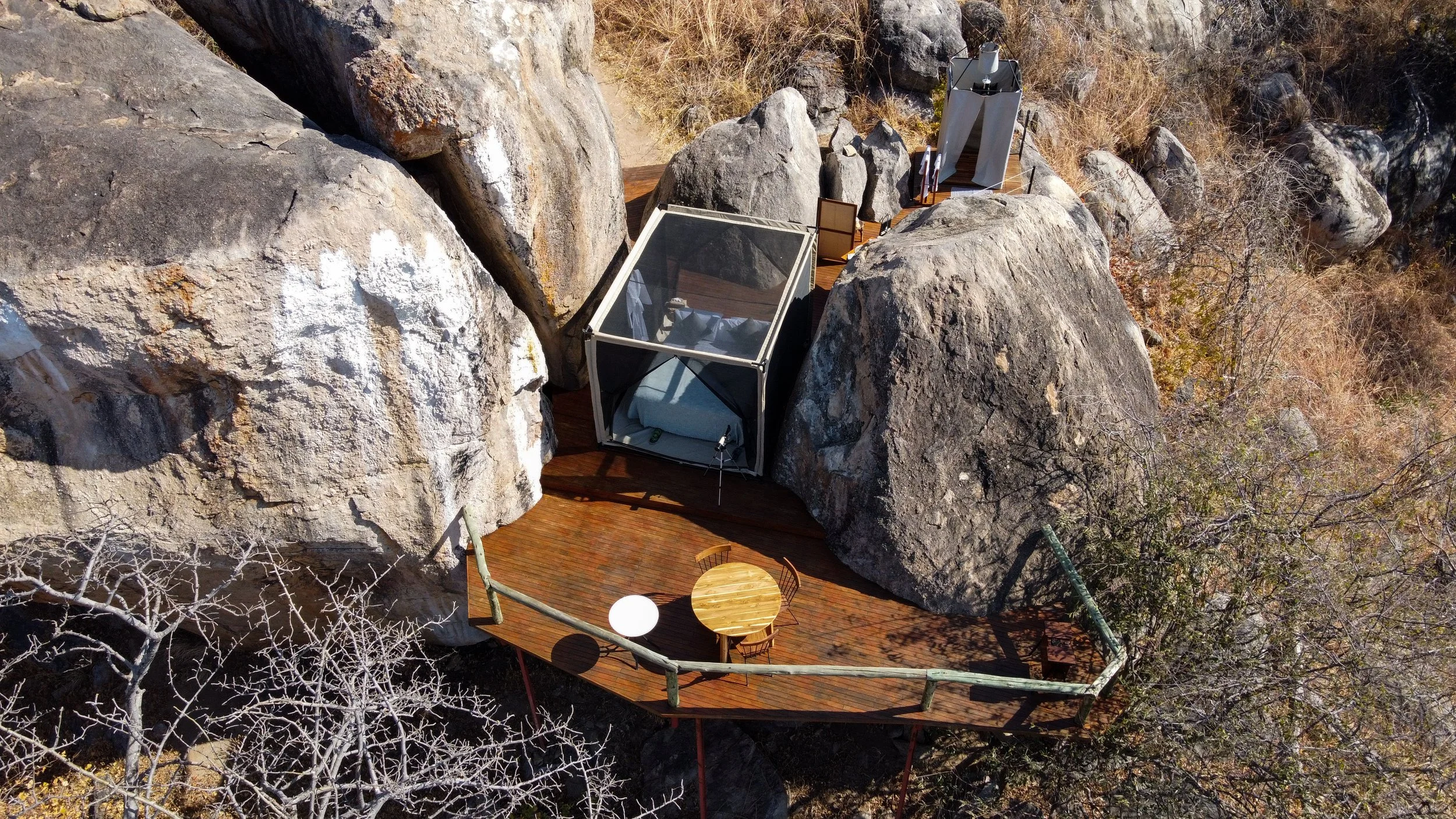
📸 : Ikuka Safari Camp’s Rock House sleep out
What Is a Sleep-Out, a Fly Camp, and a Mobile Safari?
These three terms get used loosely and interchangeably by operators, which causes real confusion when clients are trying to compare options. None of these is objectively 'better' than the others — they suit different travellers and different points in an itinerary. Part of my job is matching the right one to you, not just the one with the best marketing photos. Here is how I explain the difference:
| Sleep-Out Deck | Fly Camp | Mobile Safari | |
|---|---|---|---|
| What it is | A fixed, elevated open-air platform near your main camp, usually with a proper bed and en-suite | A small temporary camp of walk-in tents, set up for one or two nights away from the main camp | Camp itself moves every few days, following wildlife and river routes on foot or by vehicle |
| Comfort level | High — real mattress, bedding, often a private bathroom below or attached | Simple but comfortable — camp bed, bucket shower, shared facilities | Ranges from simple to genuinely comfortable, depending on operator |
| Best for | First-timers to open-air sleeping who still want a safety net close by | Travellers wanting a taste of remoteness without committing a whole trip to it | Experienced safari-goers who want total immersion and are happy to rough it a little |
| Typical length | One night, as an add-on to a normal camp stay | One to two nights, usually mid-itinerary | Three nights or more — it's the whole point of the trip, not an add-on |
Why the Dry Season Is the Best Time
Peak dry season across most of these destinations — roughly June through October — is when sleep-out decks, fly camps and mobile operations are running at their best. Clear skies mean genuine stargazing rather than a gamble on cloud cover, water sources are concentrated so wildlife movement past camp is more predictable, and — in the case of mobile and walking safaris in particular — tracking conditions are at their most rewarding.
Where in Africa to Sleep Out
Botswana: Sleep-Out Decks and Mobile Camps in Khwai, the Delta and the Makgadikgadi
Botswana leads the way on sleep-out infrastructure. One of the best-known is Natural Selection’s Skybeds — three widely spaced raised sleeping platforms overlooking a busy waterhole in the Khwai Private Reserve, bookable as an add-on night alongside a stay at Sable Alley, Tuludi, Little Sable or Elephant Pan.
Camp Okavango, deeper in the permanent waters of the Delta, has its own separate Sleep-Out Deck — an east-facing platform for guests staying three nights or more, with morning tea delivered in bed as the sun comes up.
Over in the Makgadikgadi, Jack's Camp and its sister San Camp are the classic choice for a night on the pans — both run overnight sleep-outs on the salt flats themselves, often paired with quad-biking out to the site and time with the local San trackers or the camp's habituated meerkats. Leroo la Tau, on the edge of the pans, is a lower-key alternative base for the same experience.
Botswana also leads the way in mobile safaris, operators like Golden Africa can put together luxurious, private mobile safaris for a group of up to 12, perfect for a multi-generational family or group of friends.
For something different again, Delta Camp and Oddballs both run multi-night mokoro camping trips deep into the Okavango — guests and guides paddle out with all equipment and provisions, camping on islands as they go, for anywhere from two to eight nights. It's the closest the Delta gets to a genuine mobile safari on water.
Lucie's recommendation: Camp Okavango’s sleep out deck gets my personal seal of approval, it’s so comfortable and you feel really secure. On my wish list is the Makgadikgadi Quad bike sleep out - a solo client did this as part of a group and she loved it - her pictures were amazing,
My Botswana destination page has more detail on the Linyanti, Okavango, Chobe and Makgadikgadi areas generally.
Zambia: Walking Safaris and Some of Africa's Best Starbeds.
Zambia is where the walking safari was essentially invented, and walking safaris in South Luangwa remain some of the purest versions of this experience anywhere on the continent — a small tented camp, a professional walking guide, an armed scout, and days built entirely around what you find on foot rather than what you can reach by vehicle.
Zambia also has one of the widest spreads of proper sleep-out and starbed products anywhere on this list. Time+Tide run sleep-outs from both Chongwe in the Lower Zambezi and Kakuli in South Luangwa. Kafunta's Three Rivers Camp goes further still — every one of its five rooms has its own starbed on the private deck, so it's built into the stay rather than a special add-on. On the Zambezi, Chiawa Camp has its own dedicated 'Star Drift' platform overlooking a well-used wildlife crossing, and its sister property Puku Ridge has starbeds built directly into every villa.
Lucie's recommendation: I’ve slept out at Kafunta’s Three Rivers so can personally recommend that, it was gorgeous. There is nothing better than waking up with nothing between you and the bush but your mozzie net. Clients - a mother & daughter - absolutely loved the cool suspended tents on their Chongwe sleep out during a July safari.
Kenya: Laikipia's Sleep-Out and Fly-Camp Heartland
Laikipia deserves its own separate mention here, because it has one of the highest concentrations of genuine sleep-out and fly-camp experiences anywhere in Africa — a product of its ranch heritage, private conservancy model, and long tradition of walking and riding safaris.
Sosian offers fly-camping as one of its signature experiences — guests ride or walk out to a remote plains campsite for a simple, atmospheric night under canvas and stars, with a bush dinner by the fire.
Great Plains’ Ol Donyo is located in the Chyulu Hills between Kenya’s Tsavo and Amboseli National Parks and has stunning views of Kilimanjaro. Each suite features a star bed on the rooftop, so you’re free to sleep in or out.
Ekorian's Mugie Camp in the Mugie Conservancy in northern Laikipia includes sleep-outs among its activities, alongside walking, camel treks and night drives — a family-run camp with a genuinely personal feel.
Segera Retreat's Nay Palad Bird's Nest is at the luxury end of the spectrum — a raised 'nest' with an en-suite bedroom below and an open-air rooftop bed above, arrived at with lit lanterns, champagne and a picnic-style dinner. It's one of the most photographed sleep-outs in Kenya, and deservedly so.
Loisaba Star Beds in the Loisaba Conservancy is the most established name in this space — charmingly old-school four-poster beds on wheels, rolled out onto a wooden platform facing a waterhole, with simple bedrooms available for anyone who prefers a roof.
Karisia Walking Safaris is the purest mobile safari option in the region — multi-day walking safaris supported by camels, moving camp as you go, guided by Samburu trackers, in the remoter northern reaches of Laikipia and into Samburu. This is the closest Kenya gets to Zambia's classic walking mobile tradition.
Lucie's recommendation: There is a sleep out for everyone in Kenya. For the more cautious I’d recommend Loisaba, for luxury lovers or honeymooners it’s got to be Segera or Ol Donyo, but Sosian, Ekorian and Karisia are fantastic options for adventure seekers, with Sosian particularly good for horse riders.
My Kenya destination page has more on Laikipia and the rest of the country's key areas.
Namibia: Star Beds and Sleep-Outs from Damaraland to Sossusvlei
Namibia's contribution to this category is distinctive: with some of the least light-polluted skies on earth, a night on a rooftop star bed here is genuinely hard to match elsewhere. Desert Rhino Camp in the Palmwag Concession has an outdoor star-gazing bed built into its rooms, and the area also has a dedicated Palmwag Sleep-out experience — a simpler, more back-to-basics way to spend a night in the vast concession where you're tracking black rhino by day. Down in Sossusvlei, Little Kulala offers something similar with a different landscape entirely — each chalet has a roll-out star bed on its private deck, so you can sleep beneath the Namib's famously dark skies right by the dunes.
Also in Sossusvlei Kwessi Dunes also has suites that feature their own Star Gazer rooms completely open to the sky.
Lucie's recommendation: Namibia’s nights are so starry a sleep out would be the perfect addition to a honeymoon here, or really any itinerary! Desert Rhino Camp and Little Kulala for the luxury lovers or Palmwag for the adventurous!
My Namibia destination page has more on Damaraland and the wider desert regions.
South Africa: Treehouse Sleep-Outs in the Greater Kruger
Lion Sands, in the Sabi Sand Game Reserve, has three treehouses — Chalkley, Kingston and Tinyeleti — each built into a different corner of the reserve on raised, open-sided decks with glass walls or open air, depending on which you choose. Guests are dropped off before dusk with a picnic dinner and an emergency radio, and spend the night watching the bush from a completely different vantage point to a standard lodge room. It's booked as an add-on to a stay at one of Lion Sands' main lodges, not as a stand-alone night.
For something considerably more rugged, Lowveld Trails Co. runs multi-day, fully unsupported walking safaris in the Timbavati and Makuya reserves and in the Kalahari — guests carry their own kit and sleep out each night with nothing between them and the bush. It's a step beyond anything else in this section, and suits a very specific kind of client. At the other end of the spectrum, Tswalu's Motse in the Kalahari offers the Malori Sleep-Out Deck — a king-size bed on a raised platform in the middle of the reserve, reached after dinner under the stars.
Lucie's recommendation: These are very different set ups and would suit a wide range of travellers. Tswalu’s Malori and Lion Sands’ treehouses are both perfect for luxury lovers, honeymooners and first time safari-goers. I loved my stay at both of these properties and just know that the star-bed experience will be exceptional. The Lowveld Trails options are fairly hard-core and demand bush confidence and a reasonably high level of fitness, definitely not for first timers. I’ll help you decide what’s right for you!
My South Africa destination page has more on the Greater Kruger and the country's other key areas.
Tanzania: Sleep-Outs from Ruaha to the Serengeti
Ikuka Safari Camp, perched on the Ikuka escarpment overlooking Ruaha National Park, built its Rock House sleep-out into the natural formation of two huge boulders a short drive from the main camp. It's Ikuka's own take on a fly camp — a proper raised platform with a zip-up mosquito-net tent and a real bed, plus a bucket shower and toilet on the deck, with dinner served by candlelight and a guide on radio call throughout the night.
Elsewhere in Ruaha, Kigelia Camp has recently fitted a private starbed to every tent, seamlessly built into the room rather than a separate excursion. Up in Tarangire, Entara's Olkeri Camp offers a baobab sleepout as part of its activity plan, and over in the Serengeti, Asilia's Olakira Migration Camp — which follows the wildebeest migration around the park through the year — has stargazing tents designed to open up for sleeping under an unobstructed night sky.
Lucie's recommendation: Clients have raved about Ikuka andI’m on my way very soon so watch this space for updates. Asilia’s Olakira tents are perfect for first time sleep-outers as there’s no need to leave your tent - just roll out your bed!
My Tanzania destination page has more on Ruaha and the Southern Circuit.
Is a Sleep-Out, Fly Camp or Mobile Safari Right for You?
I would rather steer the right client toward the right experience than sell an idea that looks wonderful in a brochure and turns out not to suit them.
This is a good fit if you...
● Have done at least one conventional safari before and want to go deeper
● Are genuinely comfortable with basic facilities for a night or two — a bucket shower is part of the charm, not a flaw
● Want a stargazing experience that a lodge veranda can't quite match
● Are drawn to walking and tracking, not just game drives
I'd think twice before recommending this if you...
● Are on your first-ever safari and still finding your feet with the basics
● Are travelling with young children — most sleep-out and fly camp operators set a minimum age, typically 12 or above
● Are not keen on insects, heat, or being genuinely close to wildlife sounds through canvas overnight
If any of that gives you pause, that's useful information — it usually just means this is something to build toward on a future trip rather than this one.
Frequently Asked Questions
-
A sleep-out is usually one night spent on a fixed, elevated open-air platform close to your main camp — you still have access to the main camp's facilities. A fly camp is a small, fully temporary camp set up away from the main lodge, typically for one or two nights, with simpler facilities like a bucket shower and long-drop toilet.
-
Yes, when it's run properly by an experienced operator. Sleep-out decks and fly camps are positioned and managed by guides who know the area's wildlife movement, and most have a guard or guide stationed nearby overnight. It is a controlled, carefully managed version of being close to nature — not an unsupervised night in the bush.
-
A mobile safari is a trip where the camp itself relocates every few days, following wildlife movement, river levels, or a walking route. Unlike a fixed lodge, the whole operation — tents, kitchen, and crew — packs up and moves with you, which is what gives mobile safaris their particularly immersive, expedition-like feel.
-
It isn't a strict requirement, but I generally recommend it to clients who have done at least one conventional lodge-based safari first. Knowing what to expect from the wildlife, the sounds, and the pace of safari life in general makes the step up to sleeping in the open much more enjoyable rather than overwhelming.
-
This varies by operator, but a minimum age of 12 is common, although some mobile safari operators take children of all ages. If you're travelling with children, tell me their ages early on and I'll steer you toward operators with the right policies rather than ones that will turn you away on arrival.
-
Kenya's Laikipia region has the widest concentration of genuine sleep-out and fly-camp experiences, spread across several private conservancies. Botswana is strongest for purpose-built sleep-out decks and mobile safaris in the Linyanti and Makgadikgadi. Namibia offers exceptional stargazing sleep-outs thanks to minimal light pollution, South Africa's Sabi Sand has treehouse sleep-outs, Tanzania's Ruaha has a distinctive rock-set sleep-out, and Zambia remains the spiritual home of the walking mobile safari.
-
The dry season — broadly June to October across Botswana and Zambia — is best. Conditions underfoot are firmer for walking, water sources are more concentrated so wildlife sightings near camp are more reliable, and clear night skies make the stargazing genuinely spectacular.
Planning Your Own Night Under the Stars
Whether it's one sleep-out night added to a longer Botswana itinerary or an entire trip built around a mobile camping safari in Kenya, this is exactly the kind of detail I build in from the start — matched to your experience level, your appetite for basic living, and the rest of your trip.