
Kenya Safari Destinations: Beyond the Mara
Ask most people about a Kenya safari and you’ll get one answer: the Masai Mara. And it’s an entirely understandable answer. The Mara is extraordinary — an iconic landscape with iconic wildlife, and a name that carries real weight for a reason. But Kenya is enormous. It’s wildly, almost bewilderingly diverse. And if you only ever visit the Mara, you are missing a significant chunk of what makes this country one of the most compelling safari destinations on earth.
The north especially has this quality of feeling uncharted — not in a rough or uncomfortable way, but in the sense that you can spend a week out there and barely see another vehicle. That, in 2026, is increasingly rare. This post is for the return visitors who want to go deeper, the adventurous first-timers ready to do something properly different, and the families or couples who want more than a tick-list safari.
Here’s your introduction to Kenya’s other world.
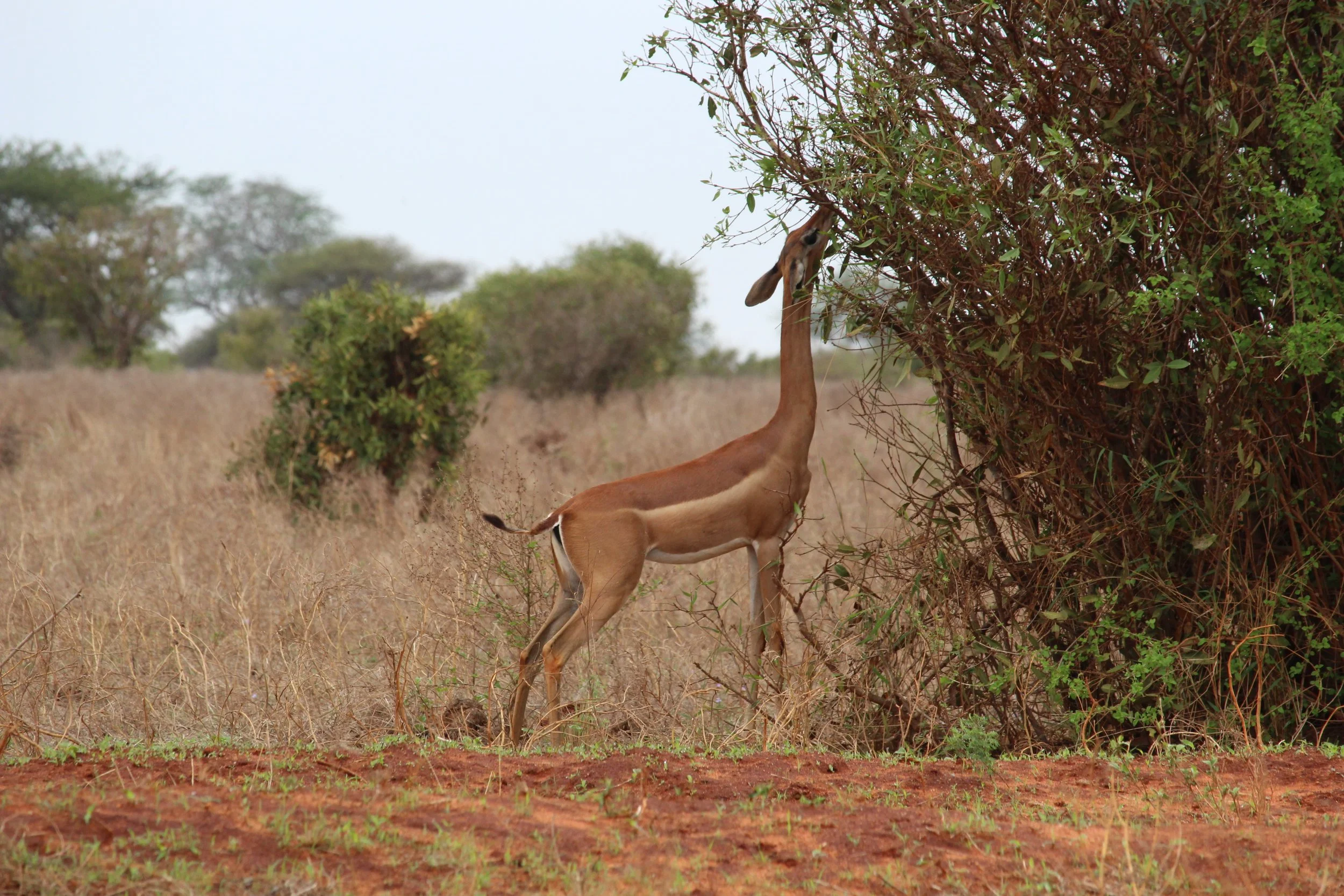
📸 Gerenuk antelope are one of Kenya’s ‘Northern 5’
Samburu: Where the North Begins
If I had to choose one place to introduce someone to northern Kenya, it would be Samburu. The landscape alone stops you in your tracks — a semi-arid wilderness of red dust, rocky outcrops, doum palms and the Ewaso Ny’iro River threading through it all like a lifeline. This river is everything. Elephant herds wade across it, leopards lounge in the fever trees along its banks, and crocodiles eye everything with ancient reptilian indifference.
The real draw for wildlife lovers is the Northern Five — species found here that you won’t easily see elsewhere. Reticulated giraffe (the most beautiful of all the giraffe subspecies, with their crisp geometric markings), Grevy’s zebra with their fine pinstripe coats, Beisa oryx posing like elegant sculptures on the plains, the long-necked gerenuk grazing upright on its hind legs, and Somali ostrich in their blue-legged breeding finery. It’s a completely different wildlife palette from the south, and it’s addictive.
The Samburu people are extraordinary too — a pastoralist community with a fierce, proud culture, vivid beadwork, and a relationship with this landscape that goes back millenia. The best camps here offer real cultural interactions, not performances for tourists.
For camps, Saruni Samburu is a personal favourite — perched dramatically on top of a rocky kopje with views across the adjacent Kalama Community Conservancy that are hard to match anywhere in northern Kenya.
Samburu is well-positioned as a fly-in destination, making it an easy add-on to a southern Kenya itinerary. Pair it with the Mara and you have two completely different ecosystems, two completely different experiences, and a trip that covers an enormous amount of ground.
The Matthews Range: The Wild North in Its Purest Form
Beyond Samburu, the land rises into the Matthews Range — a dramatic, forest-cloaked mountain range that tumbles into the surrounding semi-desert. This is community conservancy country, and it’s one of the most exciting conservation success stories in Kenya.
The Namunyak Wildlife Conservancy sits within the Matthews Range, and it’s where you’ll find Sarara Camp — a place that features high on my recommendation list. It’s small, beautifully positioned, and surrounded by a landscape that feels properly remote.
Namunyak is also home to the Reteti Elephant Sanctuary, a community-run project that rescues and rehabilitates orphaned elephants — one of the few in Africa operated entirely by the local Samburu community. It’s a place that stays with you, and one that adds real depth to any northern Kenya itinerary.
For the truly adventurous, the wider network of community conservancies marketed collectively as The Big North opens up an extraordinary arc of wilderness stretching across Samburu, Laikipia and the far north. These conservancies — many of them community-owned and operated — represent some of the most ambitious and successful conservation work in Africa. Wildlife corridors are being restored, species are recovering, and the experience on the ground is one of true remoteness. It requires flexibility, a taste for rough roads, and a willingness to trade certainty for something more rare. For the right traveller, it’s the most rewarding thing Kenya offers.
This area isn’t for everyone. There’s little infrastructure, wildlife viewing is more unpredictable than in the main parks, and the roads are rough. But for the right traveller — someone who wants to feel the wild, who cares about where their money goes, and who isn’t dependent on daily Big Five sightings — it’s remarkable.
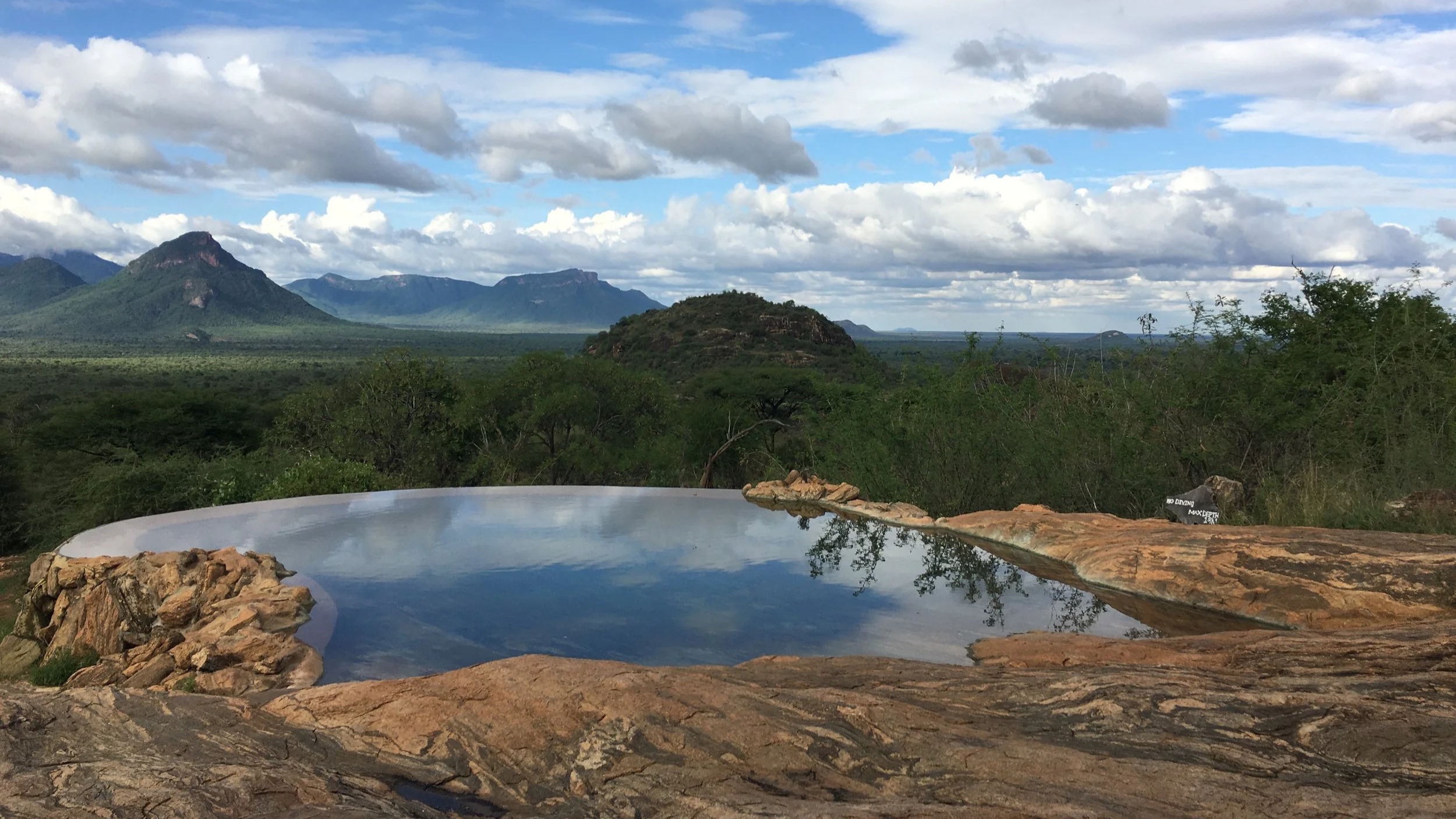
📸 Remote and spectacular, Sarara Camp has one of the best pool views in Kenya
Laikipia: Conservation at Scale
Laikipia is a huge plateau that sits north and west of Mount Kenya, and over the past two or three decades it has become one of Africa’s most significant private conservation landscapes — a patchwork of ranches, conservancies and community landholdings that collectively support extraordinary wildlife densities.
More than half of Kenya’s entire black rhino population now lives within the conservancies of the Laikipia Plateau — making it the single most important landscape in the country for the species. That’s a remarkable conservation achievement, and the sightings here are among the most reliable in East Africa. Laikipia is also excellent for wild dog (one of Africa’s hardest species to find consistently) and lion, and the landscape — open acacia grassland, rocky escarpments, seasonal rivers — gives the whole area a wide-open quality that feels very different from the Mara’s rolling plains.
The camps here tend to be intimate and consistently high quality. Ol Pejeta Conservancy is one of the most well-known — it hosts the last two northern white rhinos on earth, which is a sobering thing to witness — but Lewa, Ol Malo, Borana and Sosian all have their own character and compelling reasons to visit. Because each conservancy operates somewhat independently, you get a more personalised experience than in a busy national park: your guide knows the land, the individual animals, and often the families that run the place.
For families especially, Laikipia has real advantages. Activities like horse riding, camel trekking and night drives are widely available, and the more contained, managed nature of private conservancies means children can engage fully with the experience without the constraints of a big national park.
Mount Kenya: Above the Safari Zone
Mount Kenya doesn’t fit neatly into the safari narrative, and that’s exactly why it works so well as an add-on. Africa’s second-highest mountain sits almost precisely on the equator, which gives it an extraordinary ecology: you can walk from montane forest through heathland and moorland to Afro-alpine desert and permanent glaciers in the space of a few days. The vegetation is surreal — giant lobelias and groundsels that look like something from a science fiction landscape.
You don’t have to summit to have a meaningful experience on the mountain. The Sirimon route to around Point Lenana (4,985m) is achievable for fit, acclimatised trekkers in four to five days. And the forests on the lower slopes — part of the Mount Kenya National Park — hold buffalo, elephant, bongo (Kenya’s most elusive forest antelope), black-and-white colobus monkey and, if you’re very lucky, leopard.
For couples who want an adventure element to their trip, or for those who’ve done the standard safari circuit and want something physically demanding and visually unlike anything else, Mount Kenya is worth serious consideration.
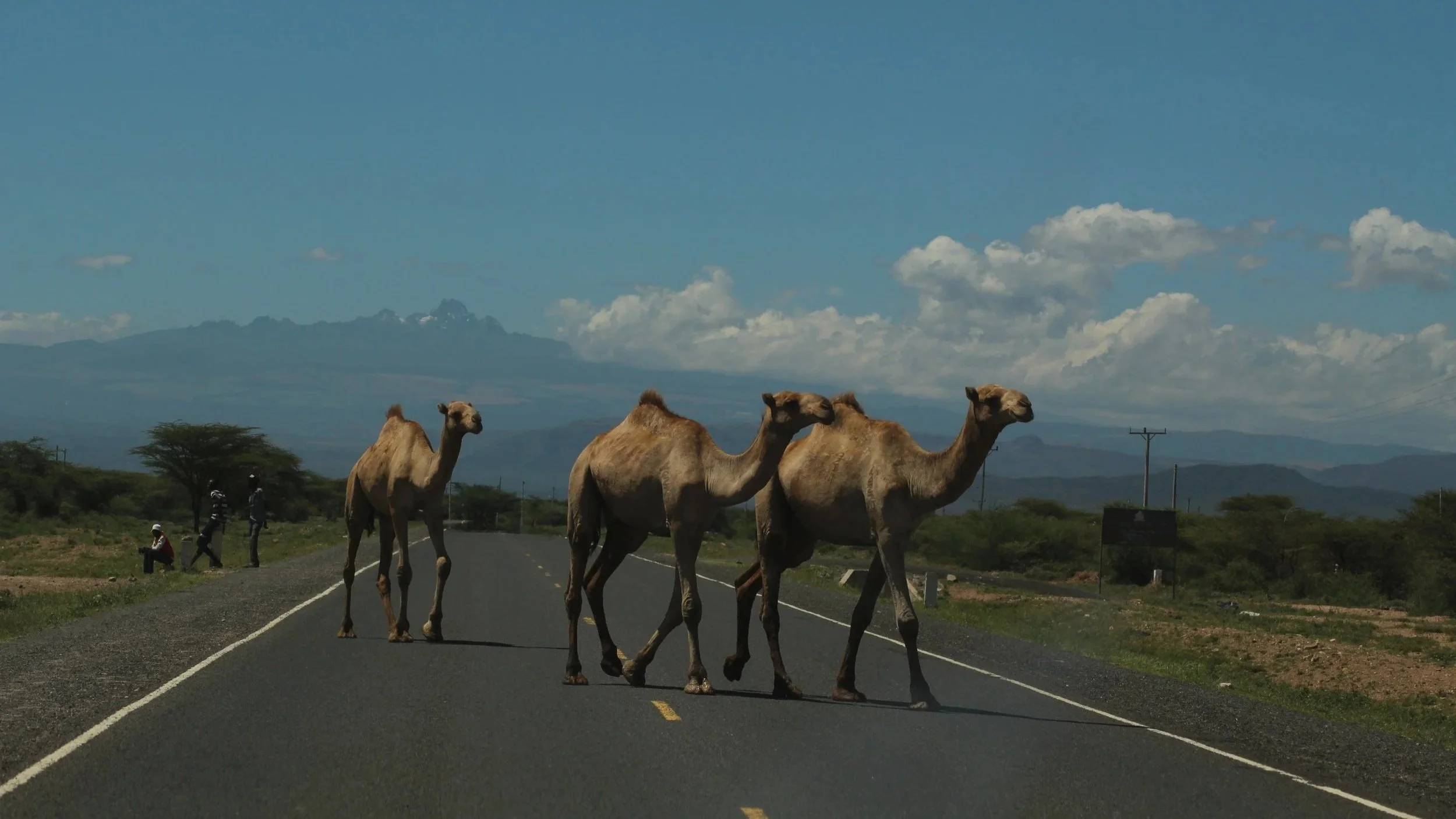
📸 Mount Kenya towers over the Laikipia Platea
The Aberdares: Forest and Waterfalls
The Aberdares are one of those places that occupies a very specific niche in the Kenya itinerary, and when the niche is right, there’s nothing quite like it. This is a high-altitude moorland and montane forest ecosystem that receives significant rainfall, creating a lush, green, almost primordial landscape of bamboo, waterfalls and mist
The famous Treetops and The Ark lodges are built on stilts above floodlit waterholes, and the concept — sitting up at night watching elephant, buffalo, rhino and bushbuck come to drink while you’re looking down from a wooden platform with a glass of wine — is unlike anything else in East Africa. It’s a bit retro, a bit colonial-era in atmosphere, and entirely its own thing. Queen Elizabeth II was at Treetops in 1952 when she learned she'd become queen — that kind of history either gets under your skin or it doesn't, but if it does, this is the place.
The Aberdares also hold some of Kenya’s most important forest elephant and black rhino populations, as well as bongo and giant forest hog. It’s a short transfer from Nairobi, making it a useful first or last night if you’re building a broader northern Kenya circuit.
Amboseli: Elephants and Kilimanjaro
Amboseli is not the north, but it deserves far more attention than it typically gets from travellers who default to the Mara. Sitting at the foot of Kilimanjaro on the Tanzanian border, it offers what is arguably the single most iconic wildlife image in all of Africa: a breeding herd of elephant moving through open marshland with the snow-capped summit rising behind them. On a clear day it’s the photo opportunity that everyone wants
Amboseli’s elephant population is one of the most studied in the world, and the individuals are deeply habituated to vehicles in the best possible sense — you can watch complex family dynamics, youngsters playing, matriarchs making decisions, at extremely close quarters. The quality of elephant interaction here is consistently exceptional, and for many visitors it’s the most emotionally resonant wildlife experience of their entire trip
The Amboseli ecosystem also supports good populations of lion, cheetah, buffalo and a remarkable diversity of birdlife around the swamps. It’s a smaller, more contained ecosystem than the Mara, which means game drives feel more focused and intimate. Paired with the Mara or the Chyulu Hills, it makes for an exceptional southern Kenya circuit.
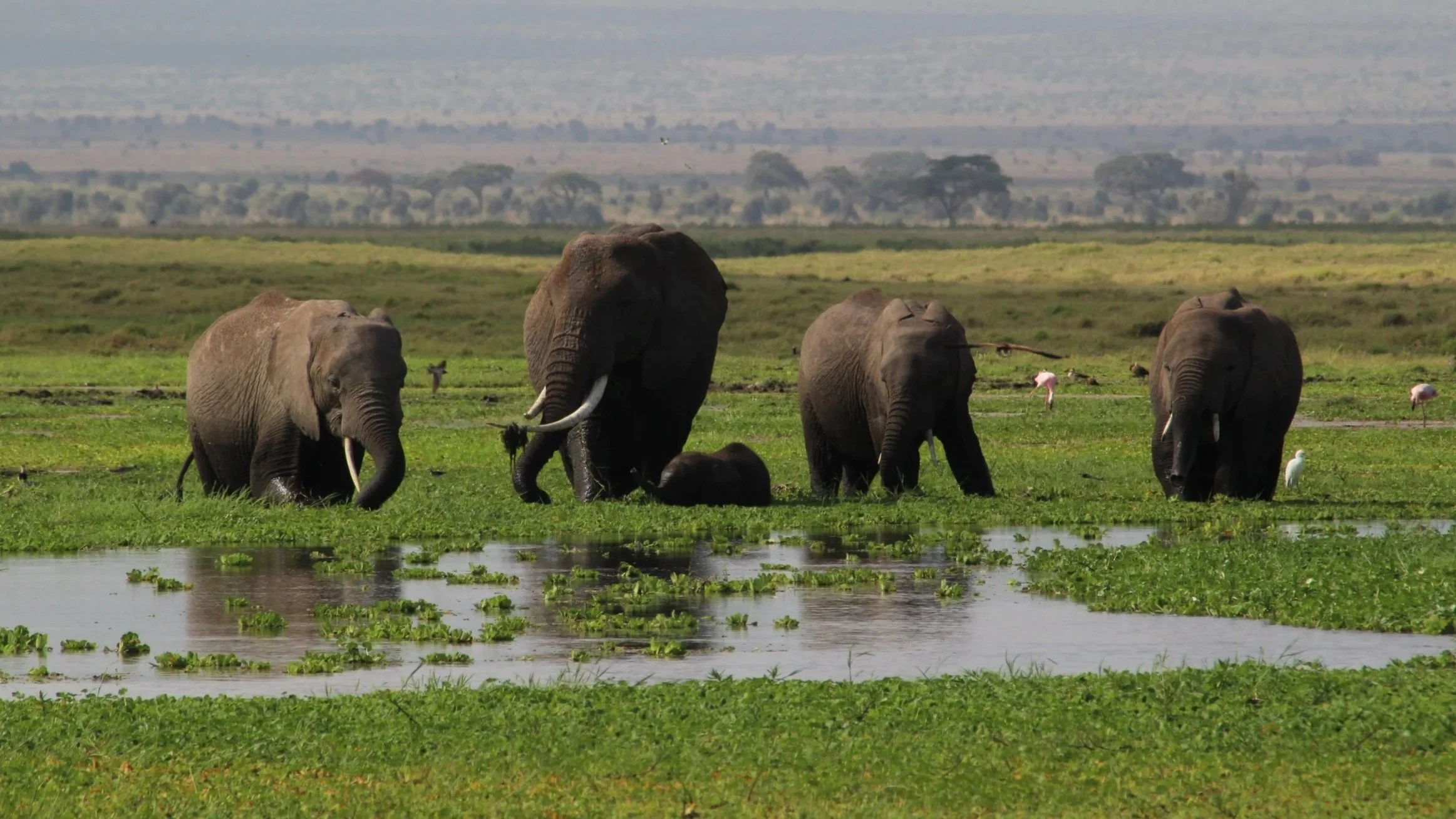
📸 Amboseli’s marshes support a huge number of elephants
Tsavo: Kenya’s Biggest Wilderness
Tsavo East and Tsavo West together form the largest protected area in Kenya, covering around 20,800 square kilometres of semi-arid savannah, lava flows, and dusty plains. It is vast in a way that is almost hard to conceptualise until you’re in it.
The red elephants of Tsavo are iconic — they coat themselves in the distinctive red volcanic soil by wallowing and spraying dust until they’re the colour of terracotta. They move through this landscape in large aggregations, and the sense of scale — both of the herds and of the terrain around them — is something entirely different from the more intimate elephant watching available elsewhere.
Tsavo West has a different character: more varied, with the Mzima Springs (where underground lava-filtered water bubbles up through papyrus and hippos drift in crystal clarity), the dramatic Shetani lava flows, and the Ngulia rhino sanctuary. The scenery is more broken and theatrical than the flat plains of the east.
Both parks sit on the Nairobi-Mombasa corridor, which makes them well placed if you’re combining a beach stay on the coast with time inland. Fly in, spend three or four nights, transfer to Diani or Lamu. It’s a very natural pairing.
Chyulu Hills: One of Africa’s Most Beautiful Landscapes
The Chyulu Hills sit between Amboseli and Tsavo, and they may be one of the most visually striking landscapes in Kenya. A range of young volcanic hills — among the youngest in the world, with lava flows as recent as the 19th century — they rise from the plains in a series of lush green ridges with Kilimanjaro visible on clear days to the south.
Clients who have visited consistently describe it as one of the highlights of their Kenya trip — particularly those who came for the riding. Ol Donyo Lodge, a Great Plains Conservation property, offers multi-day horse safaris across the hills, and for anyone who has ever wanted to do a riding safari with a backdrop that is hard to beat, this is the destination. Even for non-riders, the landscape, the walking, and the sense of utter isolation make a compelling case.
The wider ecosystem supports lion, cheetah, elephant and wild dog, and the privacy on offer here is exceptional. For honeymooners in particular, Chyulu has something that’s increasingly hard to find: complete seclusion, extraordinary scenery, and the feeling of having stumbled onto somewhere that nobody else has discovered. It combines beautifully with both Amboseli and Tsavo.
A Few More Worth Knowing About
Lake Nakuru in the Rift Valley has historically been synonymous with flamingos (the alkaline water hosts vast seasonal flocks), but it’s also a serious rhino stronghold — both black and white — and a good option for a stop on a longer overland route. Lake Bogoria, further north, is now arguably the better flamingo destination following Nakuru’s water level changes in recent years.
Meru National Park, northeast of Mount Kenya, was made famous by Joy and George Adamson and Elsa the lioness in Born Free. It’s recovering beautifully from decades of poaching pressure, with rhino now reintroduced and elephant populations growing. It still has a raw, unfinished quality — the roads are rougher, the infrastructure less polished — but that’s increasingly part of its appeal for travellers looking for something off the beaten track.
How to Build a Kenya Itinerary That Goes Beyond the Obvious
The honest answer is: this depends entirely on what you want from it. A couple who want adventure, space and romance could spend two weeks in Laikipia, Samburu and the Chyulu Hills and never once feel they were missing the Mara. A family with younger children might want the combination of Laikipia conservancies (excellent for varied activities) with Amboseli (for the elephants and Kilimanjaro) and a few days on the coast. A repeat visitor who knows the Mara well might be best served by a northern circuit: a night in the Aberdares for the novelty, three nights in Samburu, three nights in Laikipia, and finish in the Chyulu Hills. Ten nights, four ecosystems, negligible overlap with anything they’ve seen before.
There is no single right answer. Kenya is versatile enough to build around almost any combination of priorities — wildlife density, conservation ethos, adventure activities, landscape, privacy, family logistics. That flexibility, more than anything else, is why it remains one of the most consistently rewarding safari destinations I work with.
The Bottom Line
Kenya is not one safari destination. It’s six or seven, depending on how you count them, stacked into a country that is extraordinary in its diversity. The Mara is just one piece of it — a magnificent piece, but still only a piece.
If you’ve been to the Mara and loved it, there’s more. And if you haven’t been to Kenya at all yet, please know that the Mara is just the beginning.
Get in touch if you’d like to talk through what a broader Kenya itinerary might look like for you. This is exactly the kind of trip I love putting together.
Frequently Asked Questions
What are the best Kenya safari destinations beyond the Masai Mara?
Kenya has several outstanding safari destinations that are entirely distinct from the Masai Mara. Samburu in the north offers the unique Northern Five species — reticulated giraffe, Grevy’s zebra, Beisa oryx, gerenuk and Somali ostrich — found nowhere else in the country. Laikipia is Kenya’s most important rhino landscape and exceptional for wild dog. Amboseli delivers iconic elephant encounters with Kilimanjaro as a backdrop. Tsavo is Kenya’s largest wilderness, famous for its red elephants. The Chyulu Hills offer extraordinary seclusion and some of Africa’s finest horse safari riding. Each is a distinct ecosystem with its own character and wildlife.
Is northern Kenya worth visiting on safari?
Absolutely — and for the right traveller, northern Kenya is one of the most compelling safari experiences in all of Africa. Samburu National Reserve is the most accessible starting point, offering different wildlife from the south and a dramatic semi-arid landscape. Beyond Samburu, the Matthews Range and community conservancies of the Namunyak Wildlife Conservancy offer an extraordinarily remote experience. The north has an increasingly rare quality in 2026: wilderness, minimal vehicle traffic, and the feeling of being somewhere truly uncharted. It suits adventurous travellers, those who care about where their conservation money goes, and return visitors who already know the southern circuit well.
What is Laikipia known for on safari?
Laikipia is Kenya’s most significant private conservation landscape and the single most important area in the country for black rhino — more than half of Kenya’s entire black rhino population lives here. It’s also one of the best places in East Africa to see African wild dog, which are notoriously difficult to find elsewhere. The landscape is a patchwork of private conservancies and ranches, each operating independently, which means a more personalised experience than a busy national park. Laikipia is particularly well suited to families, with horse riding, camel trekking and night drives widely available across the conservancies.
How does Amboseli compare to the Masai Mara?
Amboseli and the Masai Mara offer very different experiences. The Mara is a large, open ecosystem best known for the wildebeest migration and excellent big cat sightings, with a well-developed tourism infrastructure. Amboseli is smaller and more intimate, with its defining feature being one of Africa’s most studied elephant populations set against the backdrop of Kilimanjaro — arguably the most iconic wildlife image on the continent. Amboseli is less visited than the Mara, which means a quieter, more focused game drive experience. The two combine beautifully in a single Kenya itinerary, offering real variety in landscape, wildlife and atmosphere.
What is the best time to visit Kenya on safari?
The classic Kenya safari season runs from late June to October, when the weather is dry, the vegetation is thinner and wildlife is easier to spot. This period also coincides with the wildebeest river crossings in the Masai Mara, typically peaking between July and September. That said, Kenya rewards year-round travel. The “green season” (November to May, with short rains in November and long rains from March to May) brings lush landscapes, far fewer visitors, lower rates and excellent birdlife. Amboseli is outstanding year-round. Samburu and the north are generally drier than the south and can be visited comfortably outside the main rains. The best time depends on which destinations you’re combining and what you most want to experience.