
For mountain gorillas, I would look at Uganda’s Bwindi and Mgahinga National Parks, and Rwanda’s Volcanoes National Park. For chimpanzees, I would look at Kibale in Uganda and, in western Tanzania, Mahale and Gombe. Uganda is the less expensive choice, and Rwanda is easier to reach, as Volcanoes National Park is about two hours’ drive from Kigali. Greystoke Mahale is the camp I would look at first for chimpanzees in Tanzania. All of these options can be done as a private safari, with your own guide, and the permits and transfers arranged for you.
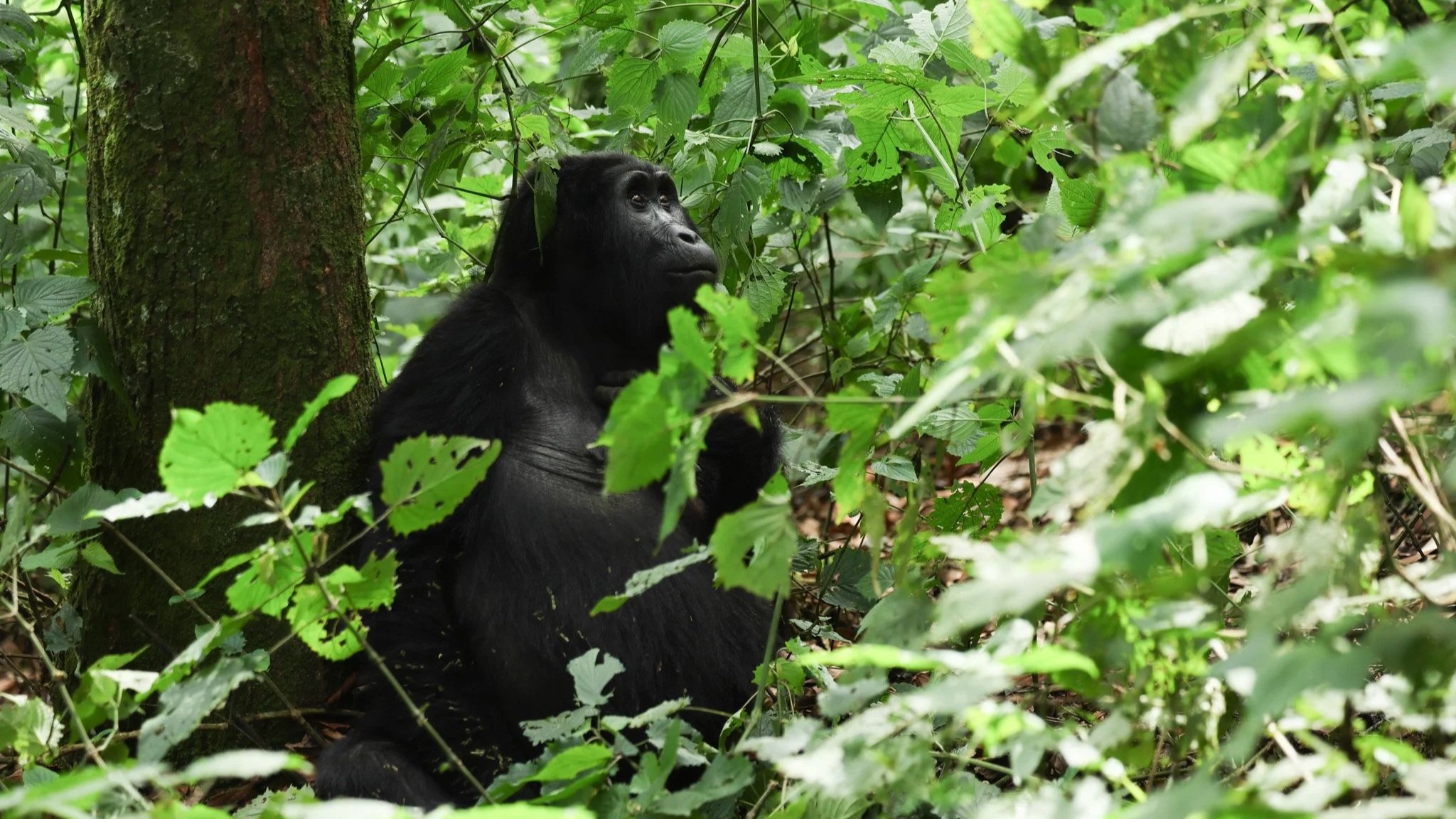
📸 : A lowland gorilla in Bwindi Impenetrable Forest, Uganda
Where can I see gorillas and chimpanzees, and what does it cost?
| Place | Best for | Permit or park fee (foreign visitor) | Best months | Getting there |
|---|---|---|---|---|
| Bwindi, Uganda | Gorilla trekking in forest. Easy to combine with Kibale chimpanzees and Queen Elizabeth National Park. | Gorilla permit US$800, or US$600 in April, May and November | Drier June to September and December to February. April, May and November are wetter and cheaper. It rained briefly during my visit in late April and early May 2025, and it made no difference to the trip. | More than 8 hours by road from Entebbe or Kampala, or a flight of about 1 hour 40 minutes from Entebbe to the Kihihi airstrip, then about 1 hour 45 minutes by road to Bwindi Lodge (60 km) |
| Mgahinga, Uganda | Gorillas and golden monkeys in the same park | Gorilla permit as Bwindi. Golden monkey tracking US$60, plus the park entrance fee. | As Bwindi | Fly to the Kisoro airstrip, or a long road transfer (about 480 km from Kampala) |
| Volcanoes, Rwanda | Gorillas on a shorter trip, close to Kigali | Gorilla permit US$1,500 | Drier June to September and December to February, as in Uganda | About 2 to 3 hours by road from Kigali |
| Kibale, Uganda | Chimpanzees at a much lower cost than gorillas | Chimpanzee permit US$250, which includes the park entrance. Full-day habituation US$300, with 4 hours with the chimpanzees. | I tracked there on 29 April 2025, one of the wetter months. It did not rain during my stay and the trekking conditions were fine. | About 360 km from Kampala by road |
| Mahale, Tanzania | Chimpanzees from a remote beach camp on Lake Tanganyika | Park fee US$108 a day in 2027. Trekking is arranged through the camp. | Dry season June to October. Green season November to March. The camp is closed from mid-March to the end of May. | Fly to the Mahale airstrip, then a boat of 1 to 2 hours. There is no road. |
| Gombe, Tanzania | Chimpanzees in the park where Jane Goodall began her research in 1960 | Park fee US$118 a day in 2027 | Drier June to October. November to May is wetter and the trails can be slippery. | Boat from Kigoma, 1 to 2 hours depending on the boat and the lake |
Which is best for gorillas, Uganda or Rwanda?
Both give you one hour per permit with a habituated mountain gorilla family, in a group of no more than eight visitors, and in both the minimum age is 15. The differences are cost and travel time.
Rwanda is easier to reach. Volcanoes National Park is two to three hours by road from Kigali, so it fits into a shorter trip, but the permit is US$1,500. Uganda's permit is US$800, and US$600 for treks in April, May and November at time of writing. The trade-off is time. Bwindi is more than eight hours by road from Entebbe. I drove there as part of a wider trip around Uganda, from Queen Elizabeth National Park, which took about two and a half hours (119 km), and flew back to Entebbe from the Kihihi airstrip in about 1 hour 40 minutes. If a client was just going to Uganda for gorilla trekking I would definitely suggest flying both directions. If a client wanted a longer safari holiday then Uganda also combines easily with chimpanzees at Kibale and a stop in Queen Elizabeth National Park and/or Murchisons Falls.
I trekked to the Rushegura group in Bwindi on 1 May 2025, and stayed at Bwindi Lodge. The trek took about three hours, including the time with the family. The trekking was quite tough, on steep slopes through thick vegetation, but the actual encounter was pretty magical and more than made up for the slog to reach the family! You can read more about my experience on my Gorilla Trekking page.
Some rules are the same in both countries. You stay a set distance from the gorillas (10 metres in Uganda, 7 metres in Rwanda), you cannot trek if you have a cold or another infectious illness, and flash photography is not allowed. Foreign visitors have to book Uganda's gorilla permits through a licensed tour operator, so on a private trip I arrange the permit for you.
When is the best time to go?
Gorilla treks run all year, so the choice is between how wet you want the forest to be and what you want to pay. At Mahale the chimpanzees move around the forest with the seasons, which changes the walk. Here is how the year breaks down.
| What | When | Notes |
|---|---|---|
| Gorillas, drier months | June to September and December to February | Easier underfoot and busier, so book permits early. |
| Gorillas in Uganda, lower permit price | April, May and November | The permit is US$600 instead of US$800. These are the wetter months, so expect rain. Low-season permits may not be changeable, so ask before booking. |
| Gorillas in Rwanda | All year | RDB's website shows one rate for a foreign adult, US$1,500. |
| Chimpanzees at Mahale, dry season | June to October | Nomad says the chimpanzees are often higher in the forest early in the season, so walks can take longer, and move to the lower slopes mid-season, when treks are often shorter. It is hot and hazy, and the lake is good for swimming. |
| Chimpanzees at Mahale, green season | November to March | Clearer air and greener forest, with some showers. Nomad says treks can be longer and less predictable. |
| Chimpanzees at Gombe | Drier June to October | November to May is wetter, with slippery trails. |
I visited Uganda in late April and early May 2025, in the wetter months. However, it only rained briefly at Bwindi and not at all during my stay at Kibale, and neither affected the treks. I’d avoid the really wet season around early April if possible as the trails are very slippery.
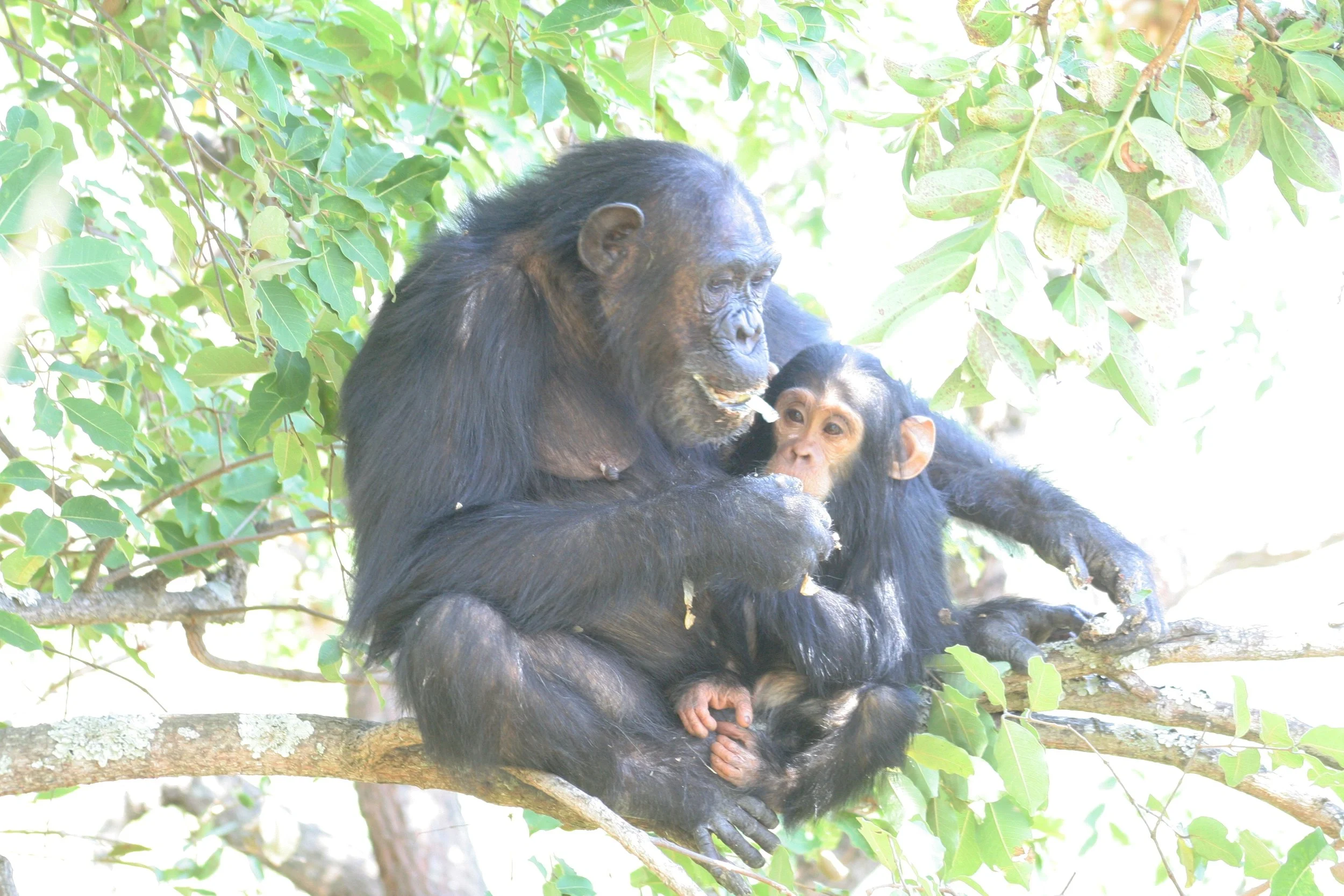
📸 : Messy eaters in Gombe Stream National Park, Tanzania
Where is the best place to see chimpanzees?
It depends on what else you want from the trip. Kibale in Uganda is the easiest and the least expensive. Mahale is the one for a remote and luxurious beach stay, and Gombe is the one for the history.
A Kibale permit is US$250 for a foreign visitor, and it includes the park entrance fee and a nature walk on the day. You get one hour with the chimpanzees, you stay at least 10 metres away, and the minimum age is 12. A full-day habituation experience is US$300 and gives you four hours with them. Kibale is in the west of Uganda, about 360 km from Kampala.
I tracked chimpanzees at Kibale on 29 April 2025, and stayed at Primate Lodge. The trek took roughly two hours on relatively level ground through fairly thick vegetation. I really enjoyed this experience, we found chimps high in the trees but then came across a pair on the ground that we followed for a while. I also really liked the lodge, it’s nestled deep in the forest and very much feels a part of the environment. I would have liked to have stayed for longer and spent more time looking around the forest for other primates & wildlife.
Gombe is where Jane Goodall began her research in 1960. It is small, about 52 square kilometres, and you reach it by boat from Kigoma, which takes one to two hours depending on the boat and the lake. The trek at Gombe was a proper hike, though no harder than my gorilla trek in Bwindi. The slopes above the lake are steep and heavily forested, but the trails are clear because the researchers use them every day. The researchers also help the guides find the chimpanzees, passing on where they are by calls and radio. The chimpanzees keep things interesting, you can often hear them before you see them as their vocalisations are really loud. They are often high in the trees, or moving quite quickly on the ground, so the best sightings come from being ready to move when they do.
Is Greystoke Mahale worth the journey and the cost?
Greystoke Mahale is the camp I would look at first for chimpanzees in Tanzania, and I have not stayed there yet, but I really want to!! What follows comes from the operator, Nomad Tanzania, and my own research.
The camp is on a beach on the shore of Lake Tanganyika, inside Mahale Mountains National Park, with forested mountains behind it. There are eight bandas, which are open-fronted wooden rooms built from reclaimed dhow wood. The forest has nine other kinds of primate besides the chimpanzees.
There is no road. You fly from Arusha to the Mahale airstrip, then take a boat for an hour or two along the lake. Shared charter flights run twice a week, so three or four nights is the usual stay. The camp is closed from mid-March to the end of May, and reopens in early June.
To get to the chimpanzees you trek from the camp, in the morning or the evening. The chimpanzees you see belong to the M community, which researchers have followed for decades . Groups are small, six people, and time with the chimpanzees is limited to one hour, at least 10 metres away . The walk can be anything from a few minutes to several kilometres of steep, hot hiking, and you need to be comfortable walking for around three hours. Sightings are likely but not guaranteed, because the chimpanzees move. The minimum age for trekking is 12.
When you are not trekking you can swim and snorkel in the lake, take a dhow out for sunset, fish or go kayaking. Nomad also supports the school and clinic in the nearby village of Katumbi, and guests can visit.
Greystoke Mahale pairs well with Nomad's Chada Katavi camp in Katavi National Park, or with a northern Tanzania safari, because the flights leave from Arusha. My Tanzania destination page has more information on safaris in the rest of the country.
Should I choose Mahale or Gombe?
Both parks are situated on the shores of Lake Tanganyika, and both are steep. Gombe is small, about 52 square kilometres, and you reach it by boat from Kigoma. It is the shorter commitment, and the place to go if the research history matters to you. Mahale is much bigger, at about 1,600 square kilometres, and has no roads at all, so the journey is part of the trip and I suggest that you would need three or four nights at either. My starting point would be Mahale for a stay on the beach with the lake and forest around you, and Gombe for a simpler trip built around the chimpanzees and Jane Goodall's story.
Are gorilla and chimpanzee treks suitable for families?
Yes, with limits. The minimum age for gorilla trekking is 15 in both Uganda and Rwanda. For chimpanzees it is 12 in Uganda, and also 12 at Mahale . You get one hour with the animals on each trek, but the walk to find them depends on where they are on the day, and it can be steep. My gorilla trek in Bwindi took about three hours in total, including the hour with the family, and the chimpanzee trek at Kibale took roughly two hours. Nobody with a cold or another infectious illness is allowed to trek, because apes can catch our illnesses, so I would build in a spare day around the trek.
What else is there besides gorillas and chimpanzees?
Quite a lot. The forests are full of other primates, and you often see them on the walk to the apes. Kibale has 13 primate species in all, including red colobus, black-and-white colobus, L’Hoest’s, red-tailed, blue and vervet monkeys, olive baboons and grey-cheeked mangabeys. Bwindi has six more besides the gorillas: chimpanzees, blue monkeys, L’Hoest’s monkeys, red-tailed monkeys, vervet monkeys and black-and-white colobus.
In Rwanda, Nyungwe Forest also has 13 primate species, including chimpanzees, olive baboons, vervet and L’Hoest’s monkeys, and a very large troop of Rwenzori pied colobus that you can track. In Mgahinga, golden monkey tracking is US$60 a person plus the park entrance fee. Volcanoes National Park in Rwanda also offers golden monkey tracking.
How do I fit primates into a private safari?
The building blocks are simple. In Uganda, gorillas at Bwindi or Mgahinga and chimpanzees at Kibale, with Queen Elizabeth National Park for a game-viewing stop in between. In Rwanda, Volcanoes after a stay in Kigali, with Akagera National Park for savannah game or Nyungwe Forest for chimpanzees. In Tanzania the possibilities are huge, Mahale after the northern parks, or paired with Katavi and Ruaha. The Uganda trip I took in April and May 2025 ran for eight days: Entebbe, Murchison Falls, Kibale for chimpanzees, Queen Elizabeth National Park, Bwindi for gorillas, and a flight from Kihihi back to Entebbe. The longest drives were about seven hours from Murchison Falls to Kibale and about two and a half hours from Queen Elizabeth to Bwindi.
Everything is private: your own guide and vehicle where there are roads, and arranged flights and boat transfers where there are none. Permits are limited, so I book them as soon as your dates are fixed. My Tanzania and Uganda destination pages have the full picture.
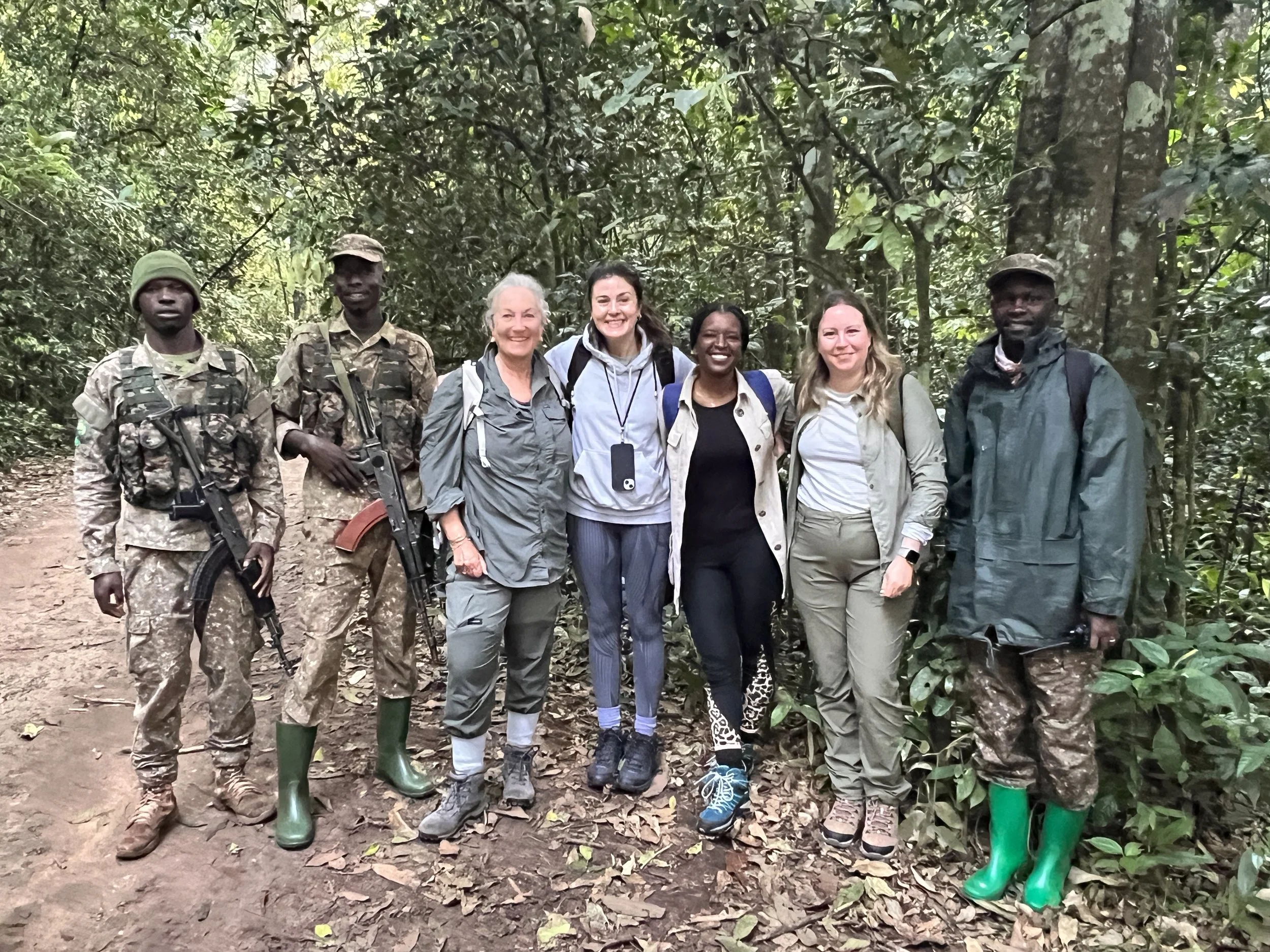
📸 :Lucie and fellow trekkers with guides and rangers in Kibale National Park, Uganda. Photographer unknown!
Frequently asked questions
-
A gorilla permit costs US$800 a person in Uganda, or US$600 for treks in April, May and November, and US$1,500 a person in Rwanda. Prices can change, so I confirm the current rate when I quote.
-
The minimum age for gorilla trekking is 15 in both Uganda and Rwanda. For chimpanzees it is 12 in Uganda, and also 12 at Mahale in Tanzania. Nobody with a cold or another infectious illness can trek.
-
Please check TravelHealthPro and speak to a travel clinic. TravelHealthPro lists a high risk of malaria in Uganda, Rwanda and Tanzania below 1,800 metres, and recommends antimalarial tablets. It recommends yellow fever vaccination for Uganda but not generally for Rwanda or Tanzania, although a certificate can be required if you arrive from a country with a risk of yellow fever. Check its Uganda page for current outbreak notices before you travel.
-
Yes. In Uganda you can trek for gorillas at Bwindi or Mgahinga and for chimpanzees at Kibale, which are all in the west of the country. Tanzania's chimpanzees at Mahale and Gombe are a separate journey, reached by plane and boat, but they can be added to a longer itinerary. On a private trip I arrange the permits, flights and transfers for you.
Thinking about seeing gorillas or chimpanzees?
Tell me when you are travelling and how much walking you would like to do, and I will suggest which place fits.